


DESERT BIGHORN SHEEP
Desert Bighorn Sheep are rare on the Navajo Nation, and only found along our northern and western boundaries. Their preferred habitat is the dry, rugged canyonlands along the San Juan, Colorado, and Little Colorado Rivers. The Department of Fish and Wildlife has put a great deal of effort into saving this species from extirpation. In the 1970s, there were less than 10 Bighorn in one population on Navajolands. Now we have over 300 sheep in three viable populations. Desert Bighorn Sheep are named ‘Tse’tah Dibe’ in the Navajo Language, which translates to ‘Sheep of the Rocks’. Bighorn sheep are sacred to the Navajo People. The horn of the sheep is used in two traditional ceremonies to restore emotional balance to patients.

ELK
Elk are the largest members of the Deer Family on the Navajo Nation, often growing to 500 to 700 pounds. They are usually found wandering the forested areas especially within the Chuska Mountain, Defiance Plateau, Black Mesa and the adjacent canyons and pinon-juniper woodlands. Elk are herbivores that feed on native grasses and forbs, and are very fond of fresh aspen sprouts. Like Mule Deer, Elk leave the high-elevations in the fall as snows storms begin.Like the Mule Deer, Elk is respected and honored. Both are important sources of food, and one should pray before eating elk meat. Their skins are very valuable to possess, especially those that are ‘unblemished’ by an arrow.

MULE DEER
Mule Deer are common residents on the Navajo Nation. They can be found mostly within the forested areas especially within the Chuska Mountain, Defiance Plateau, and the canyons that connect to these mountain features. Often one can find small groups within the deserts and butte areas as well. Mule Deer are herbivores, feeding mostly on herbs in summer and evergreens in the winter. They are known to migrate from high-elevations to low in the fall when the snow starts falling.
Mule Deer are called “Bįįh tsoh” in the Navajo language, and they are greatly honored by the Navajo People. It is said that one should pray before eating deer meat. Also deer skin (hide) is very valuable to have, especially those that are unblemished by an arrow.

BLACK BEAR
Black Bears are fairly common residents on the Navajo Nation. They can be found wandering the forested areas especially within the Chuska Mountain, Defiance Plateau, and the canyons that connect to these mountain features. They are omnivores and very opportunistic in their feeding habits. This means that they will feed on just about any plants and other animals that they encounter.
Black Bear was reported given to one of the Navajo Clans as their guide and protector as clans migrated back to Navajo Land. One should not feed, touch, or laugh at bears, and one should not call out its name in Navajo language, which is "Shush."

BLACK FOOTED FERRET
The Black-footed Ferret was once part of the historic landscape of Navajo Nation’s desert grasslands, living among their primary prey, the prairie dog. The ferret nearly went extinct due to great losses in prairie dog populations across the western U.S. in the last two centuries. Ferrets have been lost to diseases such as sylvatic plaque and canine distemper as well. The ferret had been extirpated from Navajolands since the 1940s. But now, the Navajo-tribal ranch at Big Boquillas has a successful re-introduction project since 1996 thanks to a cooperative effort between the USFWS, AZ Game & Fish Dept., Phoenix Zoo and the Navajo Nation. The ferret is an Endangered Species.
The Black-footed Ferret is named ‘Naa dloo lizhin’ in the Navajo language. The skin or hide of the ferret played was an essential item used in several traditional Navajo healing ceremonies; its hide was also used for medicine bundles.

BOBCAT
Bobcats are common residents on the Navajo Nation. They are most common in the forested areas especially within the Chuska Mountain, Defiance Plateau and Black Mesa. They are also commonly seen in desert environments. Bobcats are carnivores and opportunistic in their feeding habits. This means that they will feed on just about any animal that they can catch that are smaller than themselves.
Bobcats are named “Náshdóíłbái” in the Navajo language and are respected and greatly honored by the Navajo People.

COUGAR
Cougars, a.k.a. Mountain Lions or Pumas, are mostly found within the forested areas and canyonlands on the Navajo Nation. They are very shy, secretive and rarely seen in the wild. Often finding their tracks is the only evidence of their travels. Cougars are canivores preferring large mammals like mule deer for food.
Cougars are named Náshdóítsoh in the Navajo language. The Cougar was given to one of the Navajo Clans as their protector and guide as they journeyed back to NavajoLand.
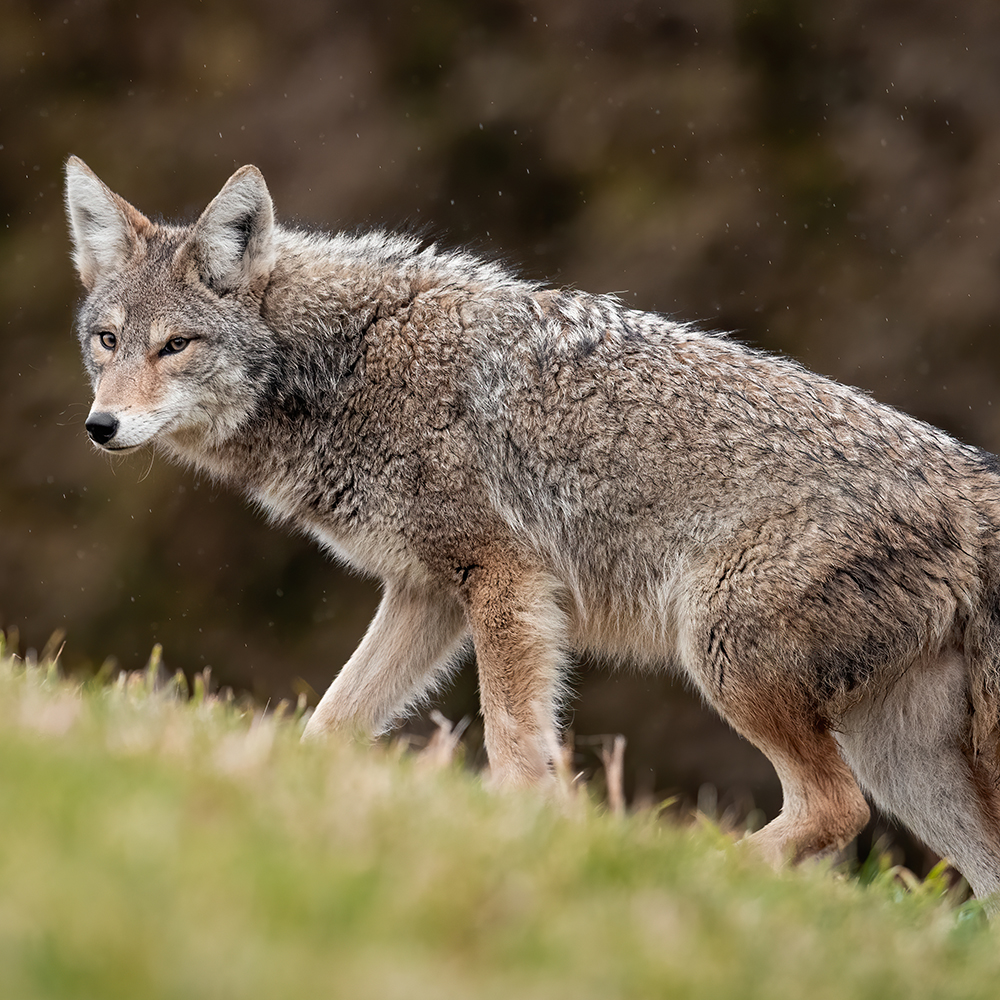
COYOTE
Coyotes are common residents on the Navajo Nation. They can be found wandering the within nearly all habitats from the low desert to the high-elevation moutains. Coyotes are social animals that live in small family groups and often hunt in pairs. They are carnivores, feeding mostly on smaller mammals, but also on birds, reptiles and carrion.
Coyotes are called “Máii” in the Navajo language and are said to posses mystical powers. They are considered as messengers and respected by the Navajo People. They are also a sacred animal because of their involvement in the Navajo Creation Stories.

GREY FOX
Grey Foxes are fairly common residents on the Navajo Nation. They can be found mostly in the high-elevation mountain forests and slightly lower in pinon-juniper woodlands. Grey foxes are the only member of the dog family that can readily climb trees. They are omnivores, eating smaller animals such as mice, birds, and rabbits, as well as fruits, berries and nuts. They tend to eat more plant matter than Red Foxes..
Grey Fox is named “Máii dootł’izhí” in the Navajo language. Gray Fox is said to posses a mystical healing power, and is used by Navajo Medicine Men during winter ceremonies.

MEXICAN GREY WOLF
Mexican Gray Wolves once roamed the Navajo Nation, and the southwestern U.S. until around the 1970s. Wolves were targeted for elimination since the early 1900s when they were viewed as a threat to livestock and human activities. This wolf was listed as an Endangered Species under the Endangered Species Act in 1976. Recovery efforts for this animal took a big step in the 1990s when wolves were reintroduced into parts of Arizona and New Mexico in an attempt to establish wild populations. Mexican Gray Wolves are carnivores. They live and travel in packs hunting small-to-large mammals ranging in size from mice and squirrels to deer and elk.
Mexican Gray Wolf is named “Máiitsoh” in the Navajo language. The Wolf is considered as a messenger and well respected and honored by the Navajo People.

RED FOX
Red Foxes are fairly common residents on the Navajo Nation. They tend to live at lower elevations than the Grey Fox, and are often found near homes within desertlands and pinon-juniper woodlands. Red Foxes are omnivores, feeding mostly on small mammals, birds, and reptiles, but also on fruits, berries and nuts. Most of the Red Foxes native to the Navajo Nation are blonde in color compared to the red/orange color typically found elsewhere..
Red Fox is named “Máii iiłtsoí” in the Navajo language. Like the Gray Fox, the Red Fox is said to posses a mystical healing power, and is used by Navajo Medicine Men during winter ceremonies.

RACCOON
Raccoons are rather common on the Navajo Nation, but nearly always found near ponds, creeks and rivers. Raccoons spend much of their time climbing trees, especially when they are threatened. They are omnivores and very opportunistic in their feeding habits. Most (75%) of their diet is composed of animals, both invertebrates (worms, crayfish and aquatic insects) and other vertebrates like frogs, salamanders, and fish. Raccoons are well known to 'wash' their food in water prior to eating..
Raccoon is called "Tábąąh mą'ii' in the Navajo language. They are respected and greatly honored by the Navajo People.

RINGTAIL
Ringtails are also known as ‘Ringtail Cats’ or ‘Miner’s Cats’. They are rarely seen within their preferred habitat of remote, rocky canyons with water. Ringtails are closely related to Raccoons and share the trait of a white and black striped tail. And like the Raccoon, Ringtails spend much of their time in trees. They are unique in having very flexible ankle joints that can rotate 180° to aid in descending trees. Their omnivorous diet includes fruits, berries, insects, lizards, and small rodents and birds.

RABBIT
The Navajo Nation has three different species of the rabbit (hare) family on the Navajo Nation. The largest is the Black-tailed Jackrabbit, and the smaller ones are named Mountain Cottontail and Desert Cottontail. The jackrabbit is found mostly within open desertlands along with Desert Cottontails. Mountain Cottontails tend to range higher in elevation in forested habitats. Rabbits and hares are herbivores preferring to feed on many different grasses, but also on shrubs such as rabbitbrush, sagebrush and saltbush.